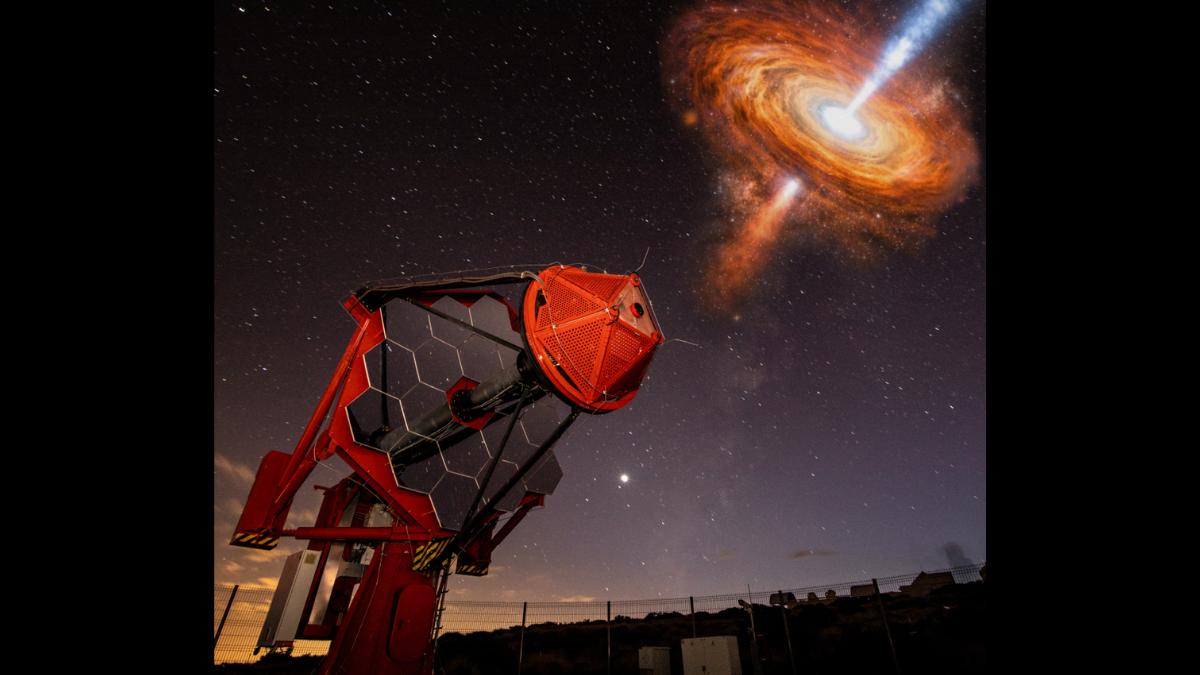
After a major upgrade and calibration phase, the ASTRI-Horn prototype on Mount Etna has proven to be a highly successful instrument. In addition to the scientific results achieved, the telescope has confirmed the validity of the technologies employed, which are also used by the ASTRI Mini-Array and the SST telescopes of the Cherenkov Telescope Array Observatory (CTAO). It will soon be used as a testbed for the study of volcanoes through Cherenkov muon observations.
Between the Amerigo Vespucci and the Teide Observatory, Silvia Casu recounts a journey that brought together research, diplomacy, and international cooperation. At its heart was the ASTRI Mini-Array, a symbol of Italy’s vision for the future of Astrophysics.
ASTRI, LHAASO, and LACT join forces to explore the TeV sky, from detecting the most energetic sources to studying them in detail. A synergy of instruments and observatories opening new perspectives on the origin of cosmic rays.
Star trails sweep across the sky above the ASTRI-6 telescope of the ASTRI Mini-Array at the Teide Observatory in Tenerife. Captured by Giovanni Lombardi (INAF) using the star trail technique, the image reveals the apparent motion of stars caused by Earth’s rotation.
A recent study published in Physical Review D has provided new constraints on primordial magnetic fields in cosmic voids, based on observations of GRB 221009A with Fermi and LHAASO. The results highlight the role of Gamma-Ray Bursts as probes of the primordial Universe and open new observational opportunities for ASTRI Mini-Array in the TeV energy range.
The ASTRI Mini-Array is currently under construction at the Teide Observatory in the Canary Islands, one of Europe’s leading astronomical sites. Thanks to its strategic location and exceptional weather conditions, the project will be able to monitor a large portion of the northern sky and the Galactic Center, ensuring high observing efficiency throughout the year.
On January 30, 2026, the renewed exhibition path of the Bologna Specola Museum was inaugurated. The new layout connects the history of Astronomy with the future of Astrophysics, featuring a CTAO-dedicated room with an ASTRI Mini-Array telescope model and segmented mirrors inspired by Guido Horn d’Arturo’s pioneering vision.
Thanks to a field of view exceeding 10 degrees and a dual-mirror optical design, ASTRI Mini-Array delivers uniformly sharp Cherenkov images across large regions of the sky. This enables the simultaneous observation of many gamma-ray sources and increases the likelihood of detecting transient phenomena.
A study on cosmic rays originating from the stellar cluster Westerlund 1 was published on 9 December in Nature Communications. The research was carried out by an international team that includes Giada Peron, a researcher involved in the ASTRI project. The results were also presented on Media INAF.
ASTRI-1, the first telescope of the ASTRI Mini-Array, observed an exceptionally intense gamma-ray emission from the blazar Markarian 421. The observation, lasting about two hours on the night of January 15, 2026, resulted in a highly significant detection in the 0.8–5 TeV energy range.
Latest news
ASTRI-Horn is back in the spotlightAugust 19, 2026 - 1:00 pm
An Italian delegation at Teide: science, diplomacy, and the future of AstrophysicsJune 10, 2026 - 2:33 pm
ASTRI, LHAASO, and LACT: a shared view of the TeV skyApril 8, 2026 - 3:44 pm
ASTRI-HORN THE PROTOTYPE
INAF observing site:
OACT, at Serra La Nave (Etna – Sicily).
ASTRI Project office
INAF Osservatorio Astronomico di Brera,
via E. Bianchi 46, 23807 Merate (LC)
For information: astri.info AT inaf.it