
An Italian delegation at Teide: science, diplomacy, and the future of Astrophysics
By Silvia Casu (INAF Officer responsible for the SRT PE and INAF-Cagliari)
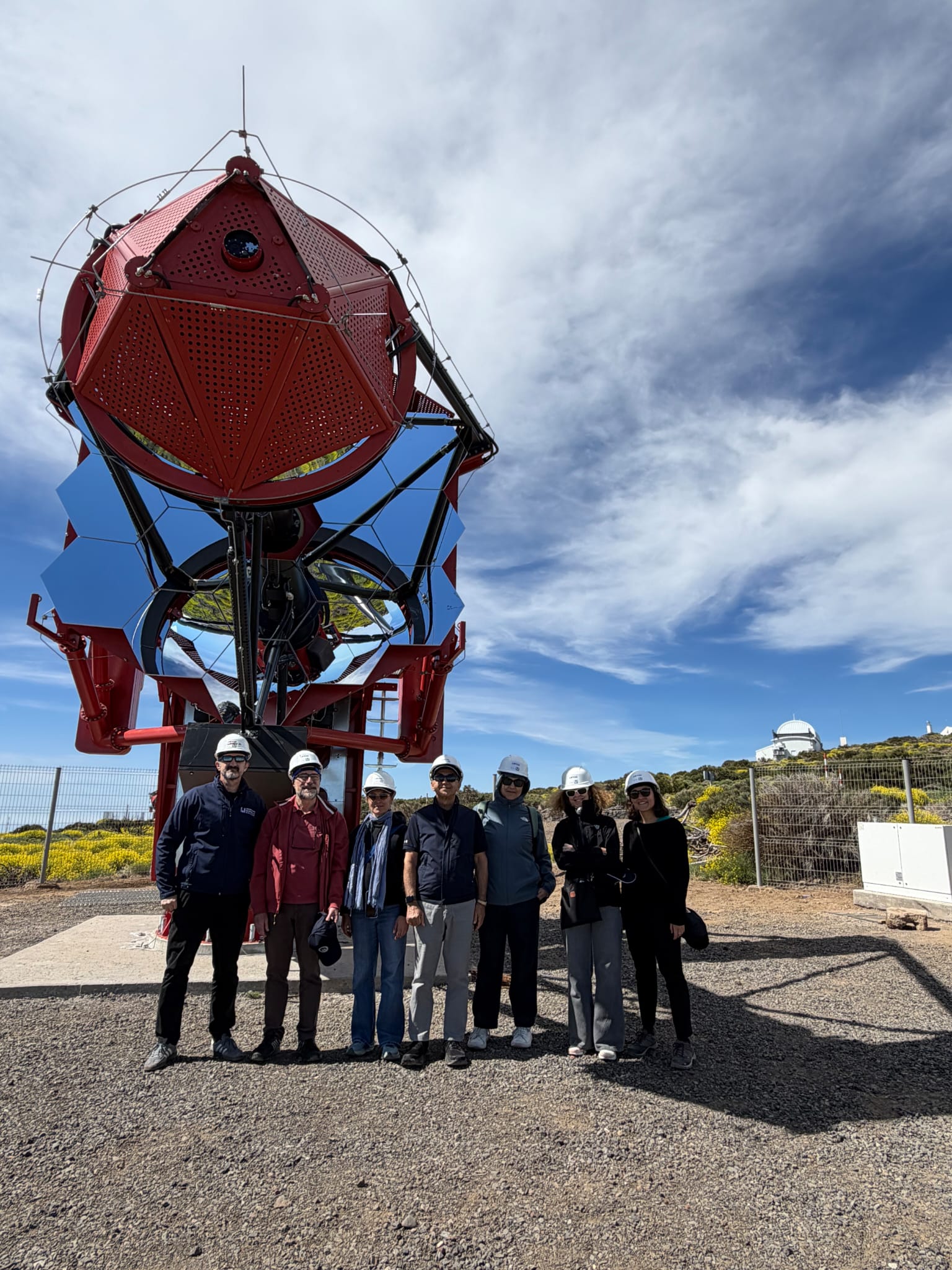
On May 22, I was on board the training ship Amerigo Vespucci, docked in Santa Cruz de Tenerife, to take part in Islas entre las ondas, a roundtable on the Italian bid for the Einstein Telescope, organised by the Italian Vice Consulate in Arona with the support of the Scientific Office of the Italian Embassy in Madrid. It was certainly an extraordinary experience, both for the topic and, of course, for the setting. But there is another experience that will stay with me for a very long time: the visit the following day to the Canary Islands Astrophysical Observatory on Mount Teide, where the ASTRI Mini-Array is located.
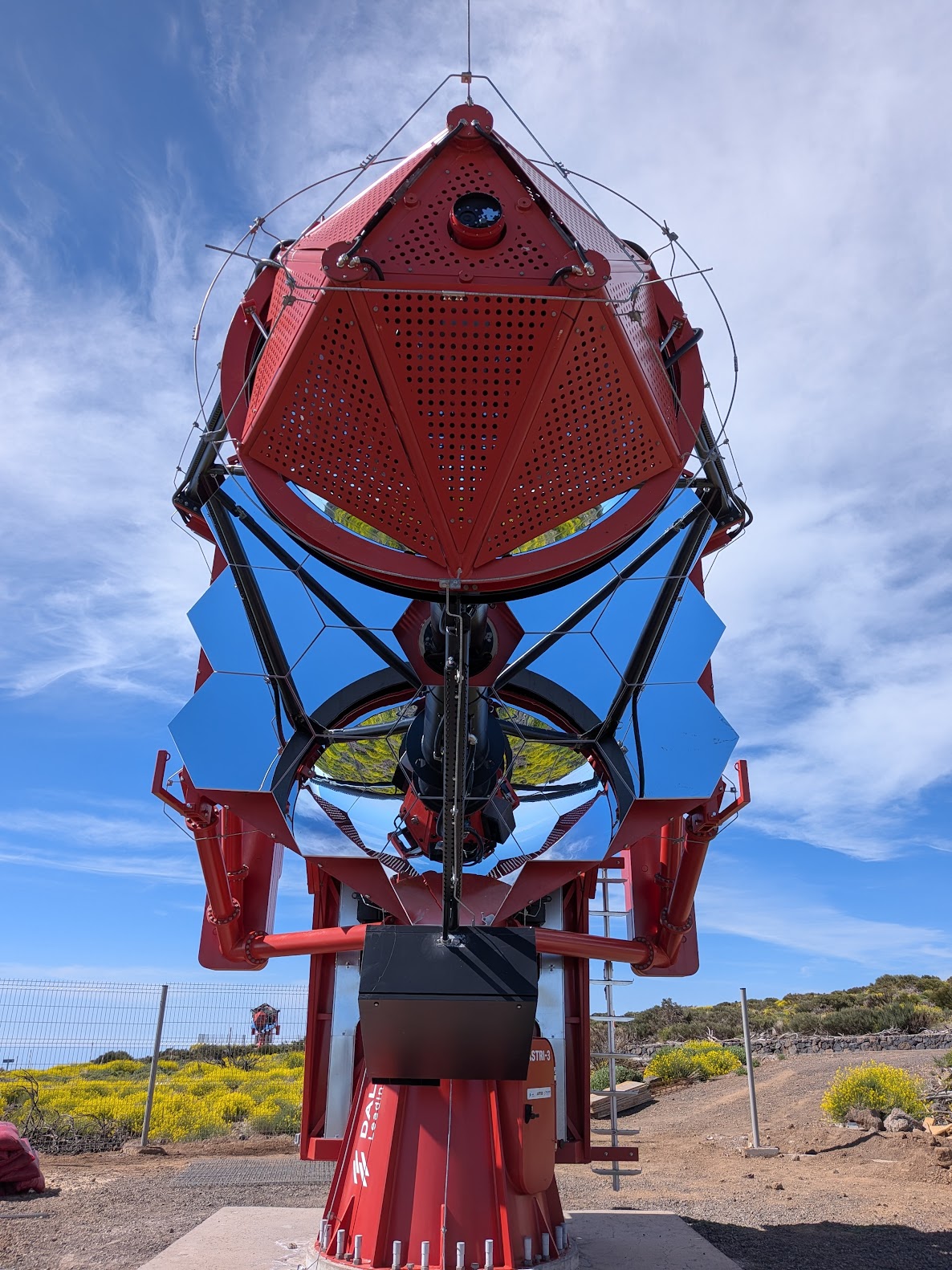
I had already been to Teide in 2013 for a European project on astro-tourism. At that time, that part of the observatory did not yet exist: there were a few telescopes and the solar tower, and then only volcanic ground, a lunar-like landscape, and the sky. Seeing it again now, with the red structures and shining mirrors emerging from the green landscape, struck me in an unexpected way.
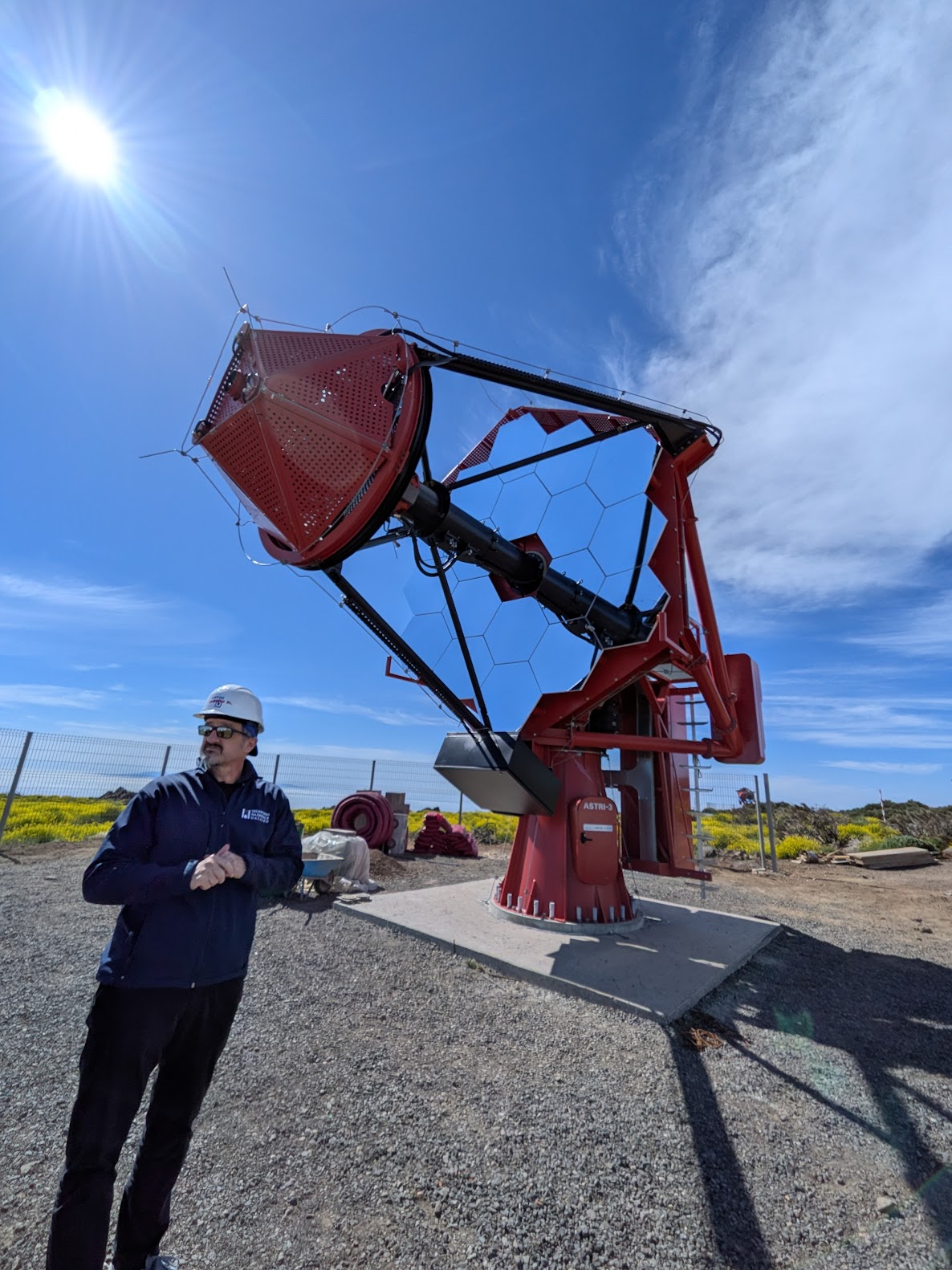
The ASTRI Mini-Array, coordinated by INAF (PI: Giovanni Pareschi), is an instrument born from Italian ingenuity to explore the invisible Universe: the one revealed only through very-high-energy gamma rays, through violent and fleeting cosmic phenomena that still hide many of their secrets. I know those telescopes on paper, from scientific publications, and from colleagues who handle their communication. But seeing them in person, at altitude with the Atlantic in the background, is a completely different kind of knowledge. It made me reflect on how much time and how many people are needed to transform a scientific idea into steel, optics, and real data.
The visit was made possible thanks to Adriano Ghedina, director of the Fundación Galileo Galilei, which supports Italian facilities in the Canaries¹, who welcomed us with the generosity of someone who knows that certain encounters go beyond any agenda. With us were Alberto Masoni, senior researcher at INFN and coordinator of the ETIC project for the Einstein Telescope, Monique Bossi, Francesca Mazzotta and Marina Picari (INFN), and Sergio Scopetta, scientific attaché at the Italian Embassy in Madrid. A small group, but one that well represented the complexity and richness of Italian Astrophysics: different instruments, different institutions, but the same direction of vision.
¹ First and foremost the Telescopio Nazionale Galileo, but now also the ASTRI Mini-Array and the STRIP telescope for studying the cosmic microwave background radiation.
This post is also available in: Italian


