
ASTRI in the Canary Islands: an outstanding site from a meteorological perspective
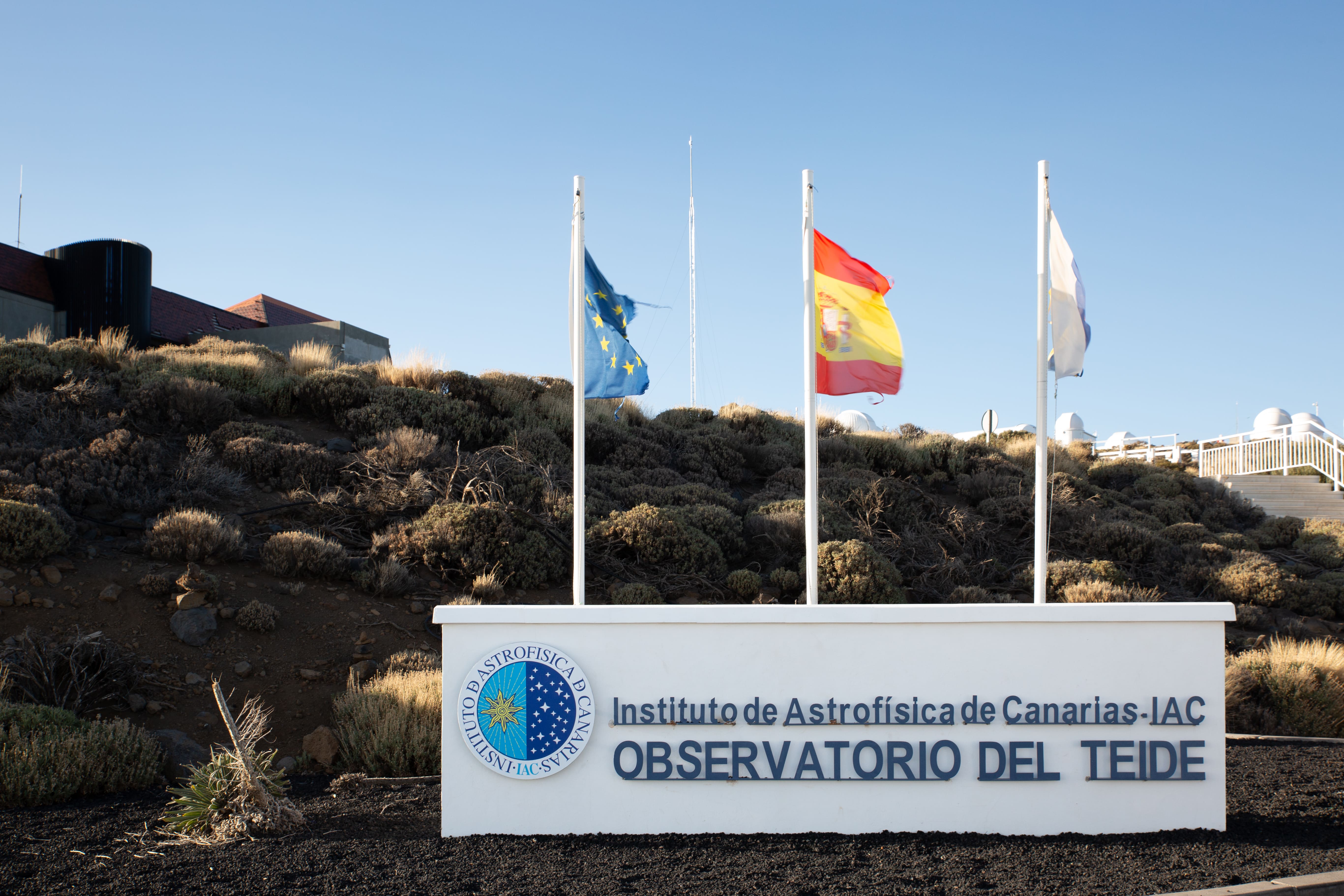
The Canary Islands host two of the most renowned astronomical sites in the world for the quality of their observing conditions, considered the most important in Europe for ground-based optical, infrared, millimeter, and gamma-ray astronomy. These are the Teide Observatory, located on the island of Tenerife, and the Roque de los Muchachos Observatory, on the island of La Palma. Both are operated by the Instituto de Astrofísica de Canarias (IAC).
It is within this framework of excellence that the ASTRI Mini-Array is being developed. The selected site is located in Tenerife, at the Teide Observatory in Izaña, at coordinates 28° 17′ 60″ North – 16° 30′ 21″ West. This strategic position allows coverage of most of the northern sky in gamma rays and also enables observations of a significant portion of the southern sky. In particular, during the summer season, it will also be possible to observe the Galactic Center region, one of the most important scientific targets in high-energy Astrophysics.
The outstanding performance expected from ASTRI is closely linked to the meteorological conditions of the archipelago. The Canary Islands benefit from a stable subtropical climate throughout the year: they are located at latitudes close to the equatorial belt and outside the main paths of tropical storms and monsoons. This configuration results in an exceptionally stable and clear atmosphere.
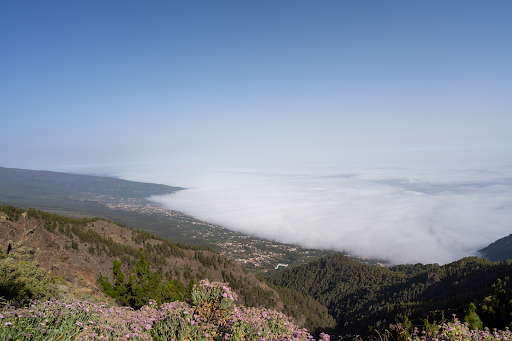
The astronomical observatories, including the ASTRI Mini-Array site, are located at about 2,400 meters above sea level, above the thermal inversion layer known as the Alisio, typically found between 1,000 and 1,600 meters in altitude. This layer separates two distinct atmospheric regimes: below it lies the more humid marine boundary layer, while above it extends the free troposphere, characterized by dry air and greater stability.
Being located above the inversion layer means operating above the so-called “sea of clouds,” under generally clear conditions and with low atmospheric turbulence. The Alisio inversion layer is a semi-permanent phenomenon, present about 78% of the year. Its altitude and thickness vary seasonally: in winter, it is found at higher elevations (between 1,350 and 1,850 meters above sea level) and is thinner, while in summer, it descends (between 750 and 1,400 meters) and becomes thicker.
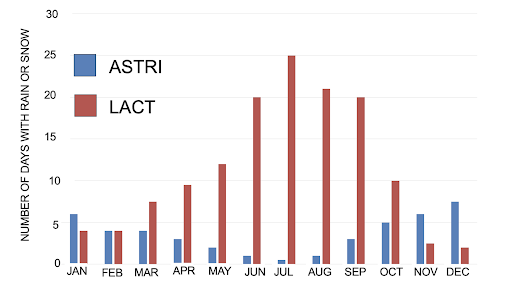
The result is a high percentage of usable observing nights. The average cloud coverage recorded at the Teide Observatory, home of the ASTRI Mini-Array, is significantly lower than that of other international sites under development for Cherenkov astronomy. One example is the site in Tibet, where the LACT (Large Array of Imaging Cherenkov Telescopes) array is currently under development and is strongly affected by precipitation during the summer monsoon period. Under such conditions, the observation of regions of great interest for gamma-ray astronomy, such as the Cygnus constellation, is severely limited.
In this context, ASTRI will be able to operate almost continuously throughout the year, ensuring a highly efficient and globally competitive observing cycle.
Thanks to the combination of its strategic geographical position and exceptionally stable atmospheric conditions, the Canary Islands site of the ASTRI Mini-Array therefore represents an optimal choice to maximize the scientific return of the project.
This post is also available in: Italian


