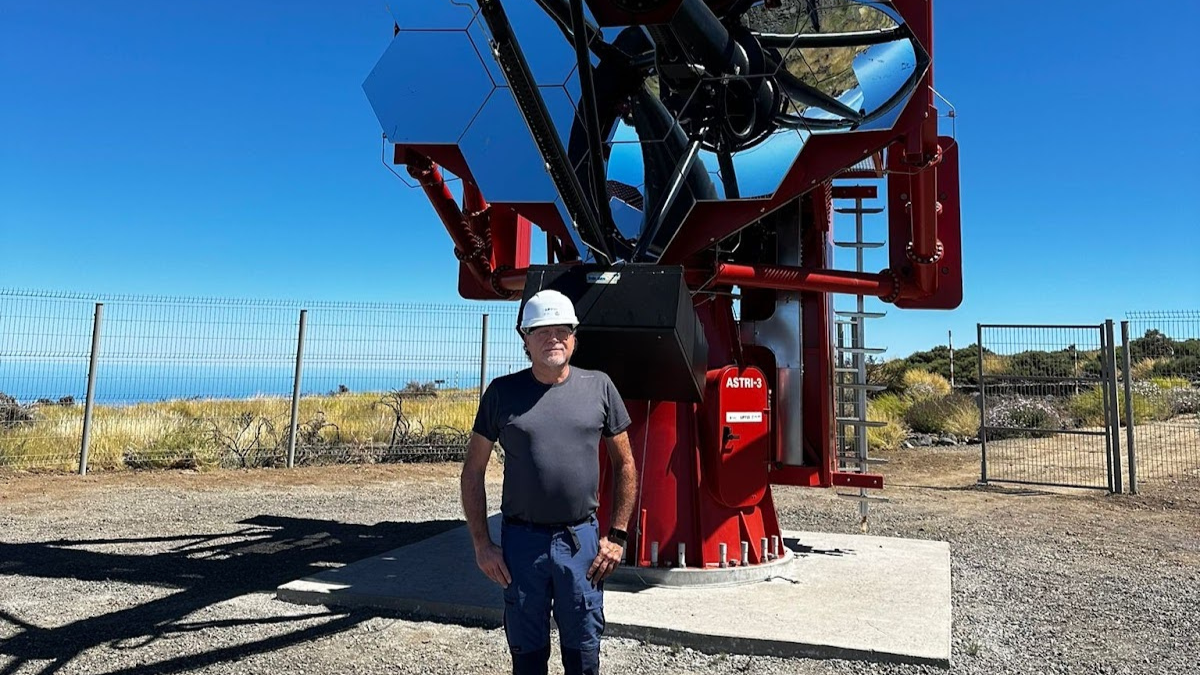
Big Wednesday… with ASTRI
[Giuseppe/Teide. Wednesday, October 29th 2025
Sara/Genoa. Wednesday, October 29th 2025]
Today is the big day. We are here to install the Cherenkov camera on the ASTRI-3 telescope. It’s a crucial step that represents the culmination of more than a year’s work by a small team. A year full of both hard work and doubts.
Antonio and I left the hotel early, before the others, because we are responsible to physically installing the camera. The crane operator is waiting for us.
When we arrive at the site, we notice that Eliecer and Alexis, the local technicians for the ASTRI support, have already removed the optical camera—the one used for the mirror’s alignment—from the ASTRI-3 structure, so now it’s our turn.
Antonio and I reach the third floor of the Themis solar telescope to bring the Cherenkov camera from the laboratory, where we had run some operational tests, to the ground floor. The camera had been prepared yesterday for the move.
Today is the big day. Tonight we’ll be on stage in the Sala del Consiglio Minore, in Genoa, for the Festival della Scienza. For a special, unprecedented event.
It’s a talk I’ve been organizing over the past few months: choosing the topics, studying the speakers’ biographies, re-reading the texts, reviewing the logistics. And of course, we need images, or maybe videos… And what if the connection fails?
Yes, the unprecedented part is not just the live connection to Tenerife, where the ASTRI telescopes are sprouting like mushrooms, but the live operation of the ASTRI-1 telescope itself! Controlled from here, from our stage in Genoa!
Eliecer and Alexis are waiting for us in the garage after storing the optical camera. I assure them we are going to transport the Cherenkov camera with the pickup truck, but only after we don our safety equipment. Clearly, my message doesn’t get through, because the camera is already in the ASTRI-3 platform when we return, taken thereby the crane. I fear we are running too much.
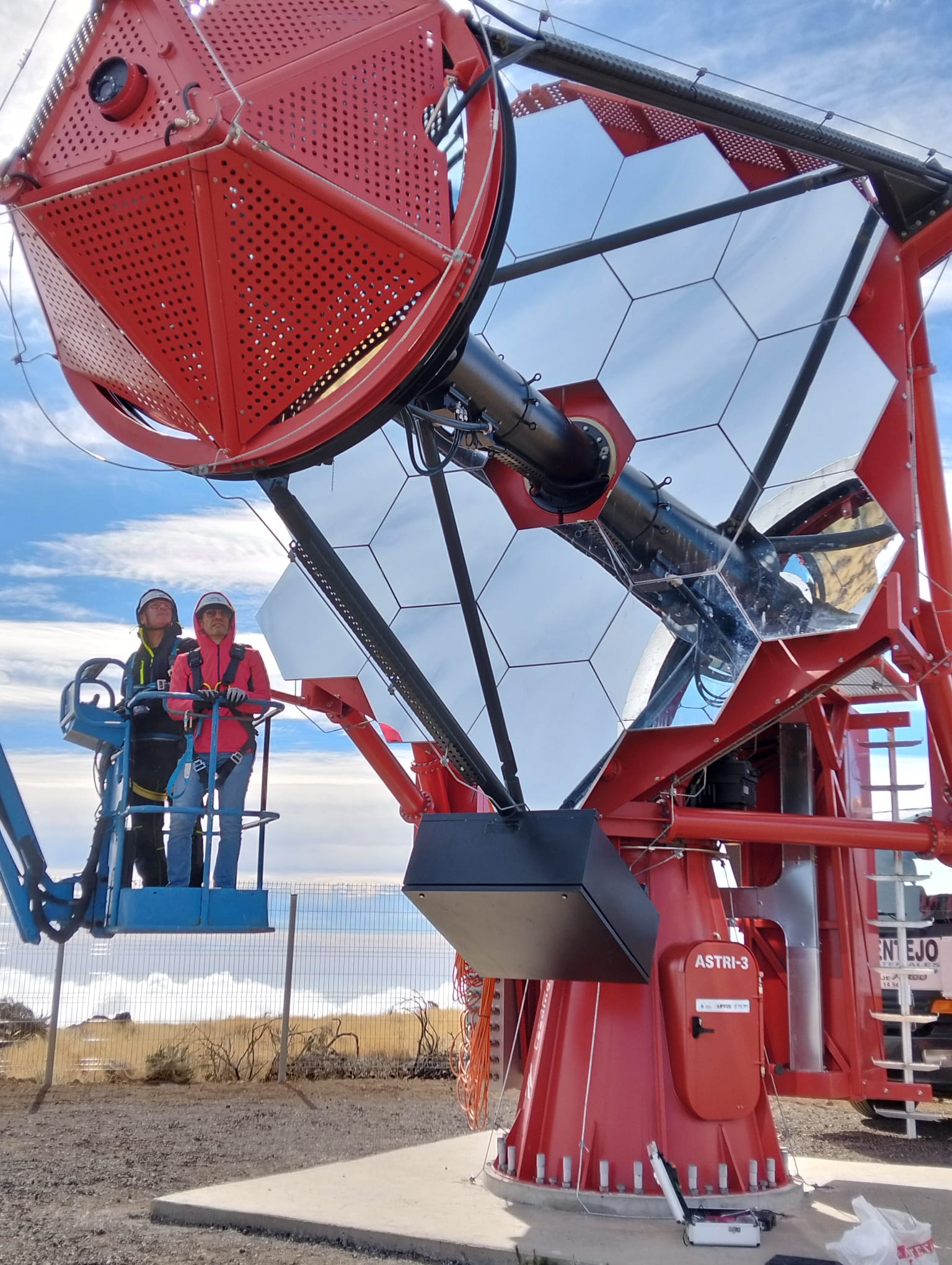
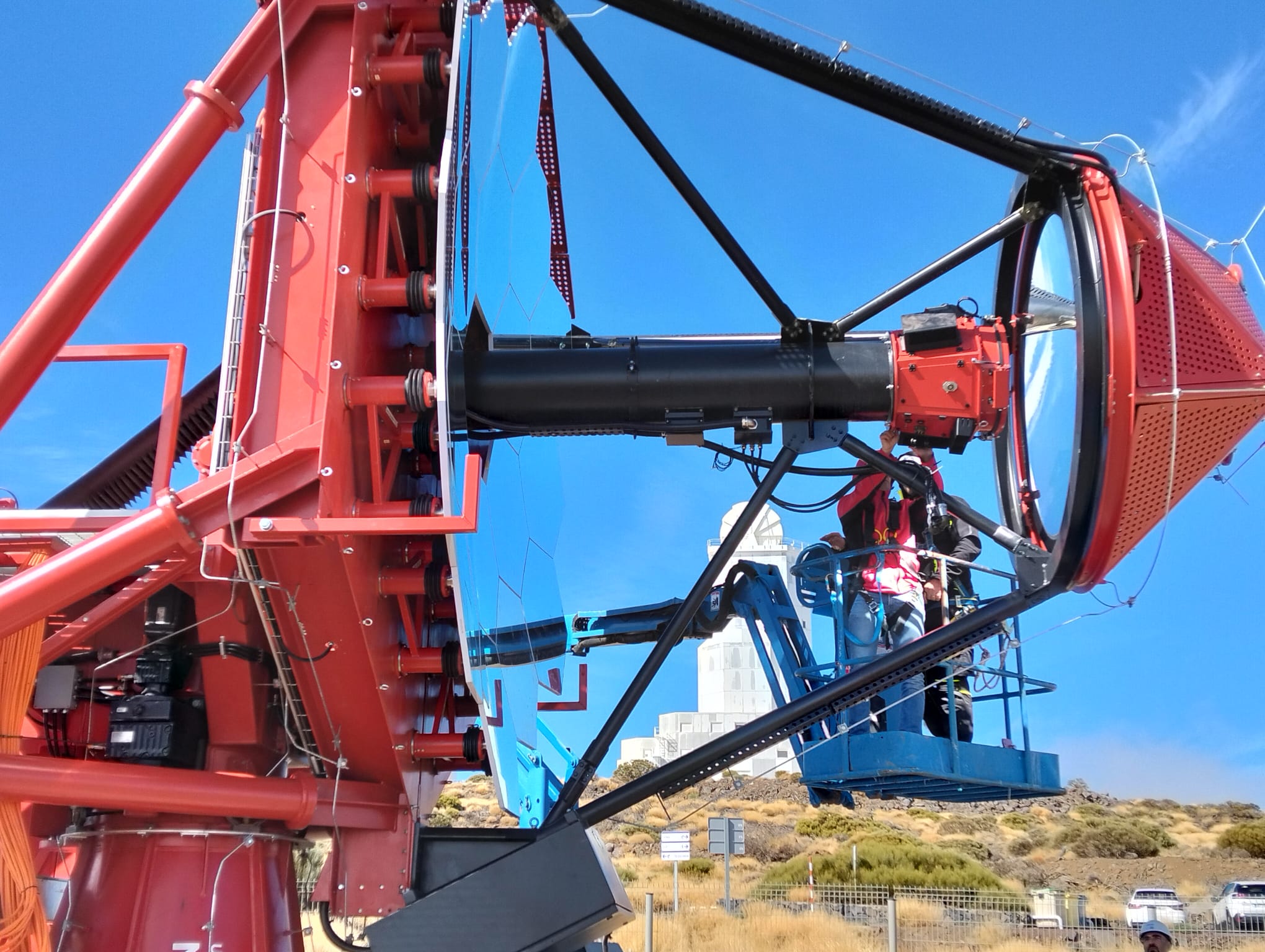
We climb onto the cherry-picker, the mobile platform that lets us reach the telescope’s focal plane, and get into position to guide the camera toward its mount. We’re ready, despite our hands freezing even with the gloves; it’s bitterly cold. The camera, which looks like a barrel about half a meter in diameter and a meter tall, is lifted very high. Despite weighing more than 100 kilograms, the wind makes it sway. We’re tense, but stay calm. The camera is lowered into position and, as soon as we can, we grab it. Guiding it is far from easy because it’s heavier and bulkier than the optical camera.
It’s the first time this mounting method has been used for an ASTRI Cherenkov camera, and it’s clear that some aspects will need improvement in the future. The space between the focal plane and the large secondary mirror is very tight, and every risk must be avoided.
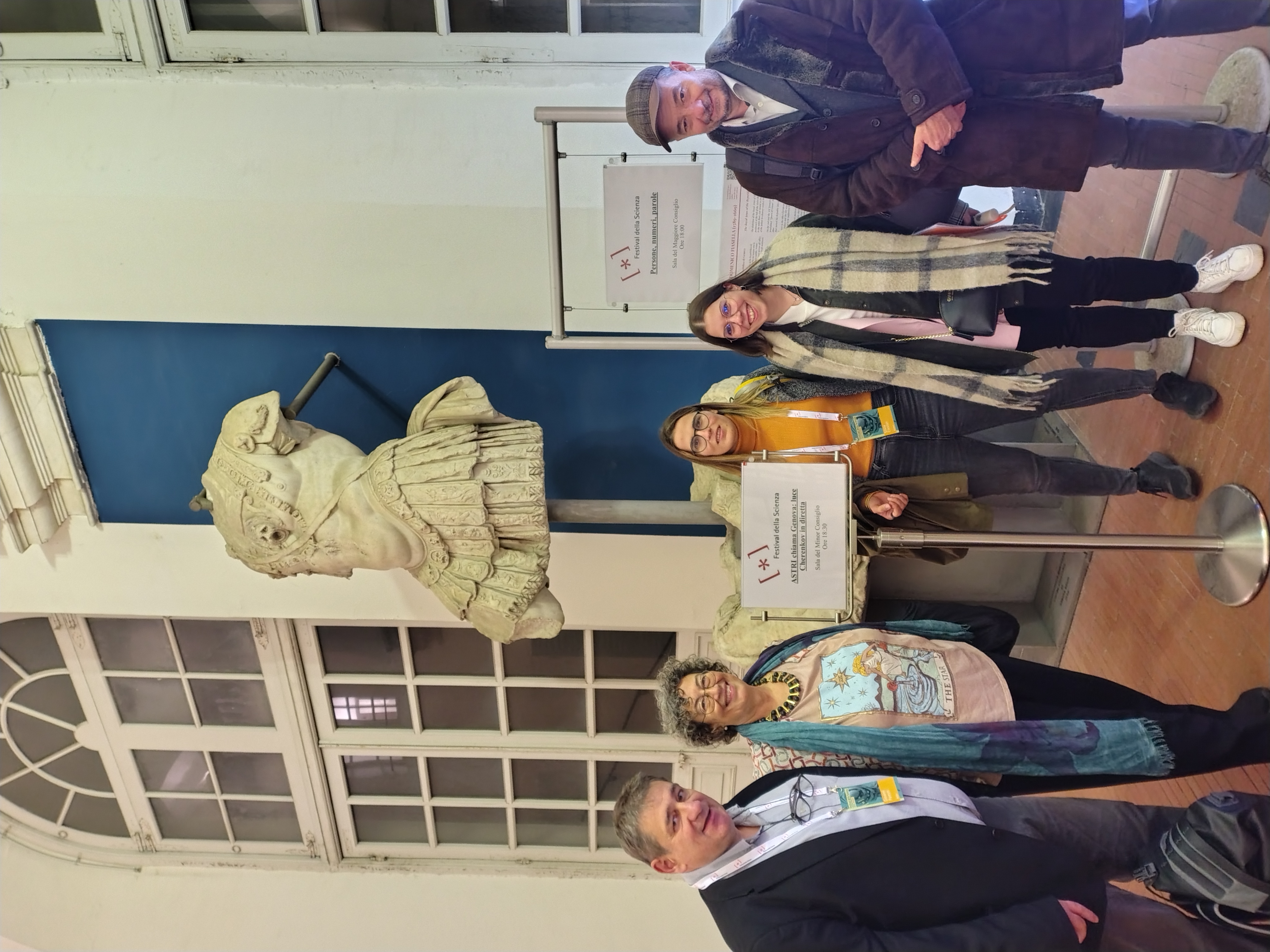
Now we’re all here together, breathing the sea air and running checks: Anna, Silvia, Andrea. Giovanni has finally arrived, too. I need to make sure they’re all clear on what they’ll have to do. Did they read what I prepared? And what if at the last minute…
Strategic meeting: we manage to review almost everything. Now we need to hand the material over to the technicians, luckily Anna helps me… The tension is rising.
The meeting with Edgar, our “man on the mountain”, went well in the past few days; he’ll surely be at ease, but we still need to verify the official connection. The control room at Teide might be occupied. We know there’s a group working on the ASTRI-3 telescope’s camera. Edgar might have a chat with them.
Our real safety net is Silvia: we rehearsed the sequence together, checked the commands to send to the telescope with the precious help of Gino, always helpful and knowledgeable: we listed the elevation and azimuth positions to send in sequence.
Thanks to his strength and build as a former rugby player, Antonio manages to stop the camera from oscillating. It’s a hard work, but in the end we manage to align it perfectly in its housing and fasten it with the six bolts, securing it to the telescope. In just a few minutes, it’s mounted; everything went smoothly.
We test the power lines before connecting the large military-grade connector. Everything is ok, so we install the power cable and the ethernet cables.
We get off the cherry-picker, numb from the cold. From the platform, we tell the rest of the team, who have now arrived at the site, that it’s time to power everything on and attempt communication with the camera.
Just a few minutes, and everything works!
I think everything went just right and quickly; perhaps we should ride the wave and attempt some sky observations tonight, without waiting any longer. The weather forecast is also favorable, while tomorrow night is uncertain. Therefore, the team decides to make one more effort and open the camera to the sky for the first time.
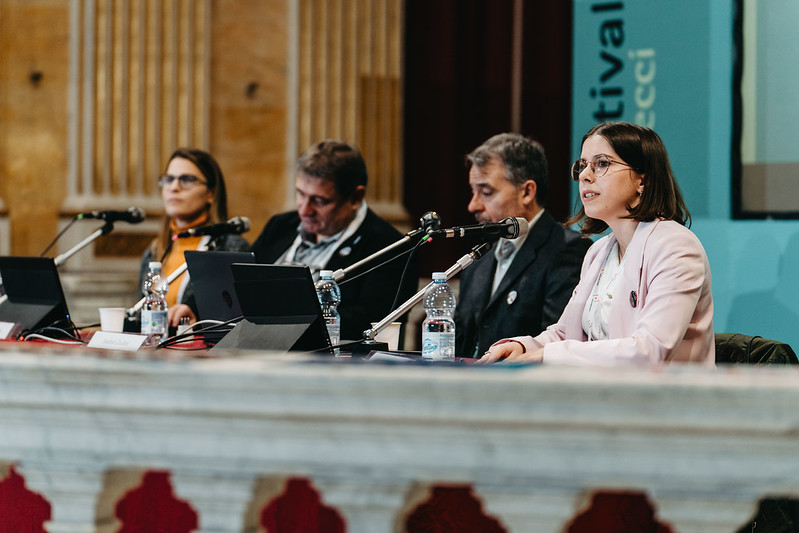
It’s already time to meet at Palazzo Ducale for the technical tests: microphones, connections. In the meantime, I rehearse the sequence again. The test with Edgar goes well, very calm; he pauses the video so as not to drain his phone battery, can’t have it die at the crucial moment!
Soon, the audience will arrive. Anxiety skyrockets… I breathe and sit down. Caterina, on behalf of INAF and the Festival, introduces the night. I tell myself: it’s fine, I wrote everything down, I have everything under control.
First round of questions: Andrea, Silvia, Giovanni… Why TeV is important, what sources we observe, and how skilled we are in Italy at building these instruments. All good, of course, but we’re running a bit late. I see Anna in the first row, restless, then talking to the technicians—I’ll later find out that Edgar had disappeared from the control console. But there he is: as soon as I call him, almost magically, his smiling face appears on the screen. At Teide, the control room is empty, but there are traces of a group working there: jackets, screens lit.
Antonio, Fabio, Vito, and I go to Esperanza to buy dinner, which we’ll cook before the night shift. The long drive is distracting, as is the cooking. After dinner, we all move to the control room to attempt the first light. Gino, connected via remote, powers up the telescope and turns on the camera. All the software systems are started and, after about ten minutes, all values are nominal: the camera is operational.
The panoramic view of the mountain, the sea of clouds beneath us, the white telescopes in the distance, and Edgar’s footsteps leading us towards the red pillars of one of our instruments. The scenery on the island is always beautiful.
We are back to Genoa with more questions, explanations, insights. The audience listens attentively. The much-awaited moment approaches: we must wait for a precise time to move the telescope: sunset must be complete, otherwise one of the ASTRI mirrors could intercept a ray of sunlight and focus it somewhere on the mountain. The last thing we need is to start a fire! At the same time, we need enough light for the webcam monitoring the telescope to send us a nice, colorful image.
Silvia takes control of the keyboard and sends the command. Nothing. She tries again. Still nothing.
I wait a few seconds. Too early? Maybe everything is frozen? I seize the moment and prompt Giovanni to step in with a story about Italy’s role in the project, the expected results, and the leap forward we can make once all telescopes are operational.
The lids, the system equivalent to a camera shutter, are open, the telescope points to the sky, and we realize it behaves exactly as expected: nothing unusual. The trigger threshold is set, and acquisition begins. After just a moment, the first trigger appears. The camera has already captured its first Cherenkov light emitted by charged particle showers from cosmic rays and gamma rays. The threshold is adjusted to capture the more intense events, the most striking, especially since the moon is increasing the background illumination.
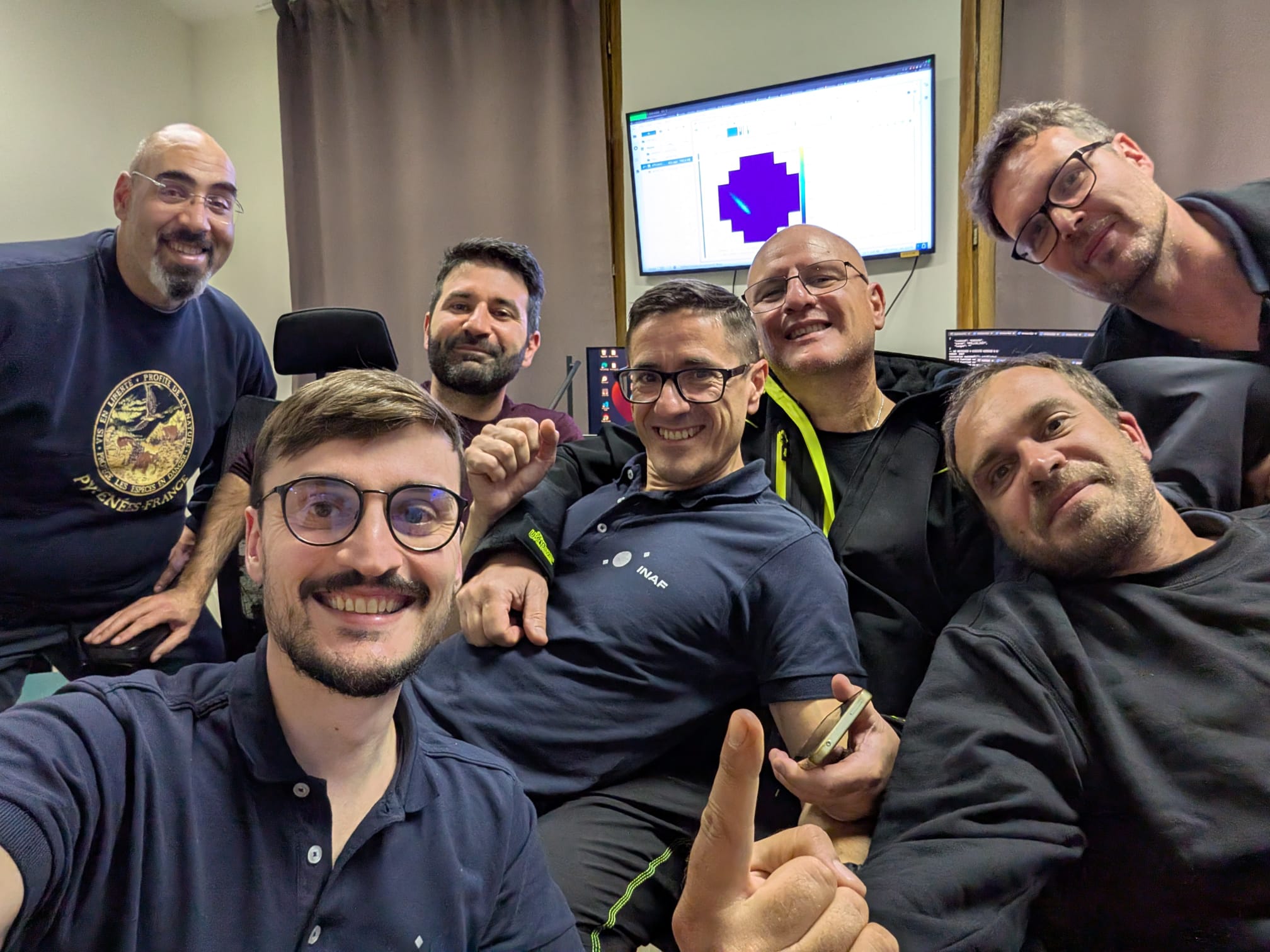
We pick one of these events, a beautiful one, almost certainly from a gamma ray, put it on the screen, and decide it will be the background for a group photo celebrating first light.
It’s a pity that Carmelo and the colleagues who stayed in Italy can’t be with us to share this moment.
Everything fast, everything perfect, the opposite of those exhausting months in the Palermo laboratory when we were assembling it.
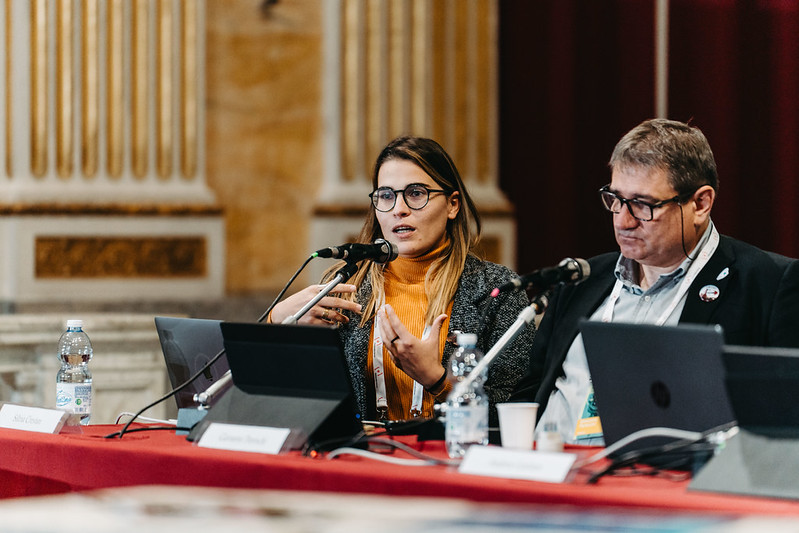
Meanwhile, Silvia, with her usual calm and expertise, takes command again. Here we go: ASTRI-1 moves, presenting itself to the waiting audience. A liberating and approving applause erupts. The telescope dances before us: the screen beside us looks like an aircraft control panel, full of red and green buttons, a jumble for non-experts.
The peak is reached, but it’s not over: there are many questions. It’s clear the audience has appreciated our work, what was on show and what’s behind the scenes that allows it. Hopefully, we managed to convey at least a bit of that.
And then, while in Genoa we turn off the microphones and the hall slowly empties, a message arrives from the Teide team: the image of the first light from the newly installed ASTRI-3 camera, the flash captured by a camera that, only hours before, had still been swaying in the icy mountain wind. The audience here applauds without knowing it, the colleagues up there smile, tired and happy, and for a moment, the two stories overlap: the same enthusiasm, the same effort, the same joy flowing through cables, optical fibers, and sleepless nights.
The photo spreads through WhatsApp, and we are flooded with messages of excitement and collaboration from Italy. Someone tells us that there’s a surprise waiting in the refrigerator at Themis. Indeed, we find a couple of bottles of sparkling wine hidden for the occasion… Happily, we celebrate!
THE MAIN CHARACTERS: Giuseppe Sottile; Antonio Micciché; Fabio Lo Gerfo; Vito Conforti; Eliecer Perez; Alexis Perez; Sara Anzuinelli; Anna Wolter; Silvia Crestan; Andrea Giuliani; Gino Tosti; Edgar Molina; Giovanni Pareschi
This post is also available in: Italian